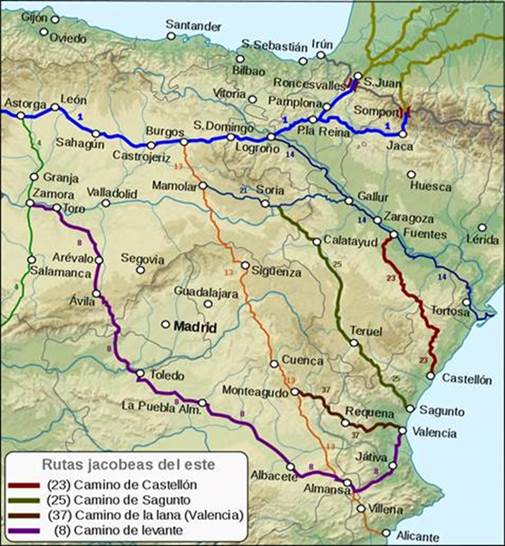


The Camino de la Lana passes through the gateway to the archaeological site of Noheda. This route is the branch of the Way of St. James that links Alicante or Valencia with Burgos (where it links up with the French Way) via Cuenca.
Stage 14 of the aforementioned Camino de la Lana (Cuenca-Villar de Domingo García) is the one that passes through the gateway of the villa of Noheda. Likewise, the Camino has pilgrim hostels in Cuenca, Villar de Domingo García and Villaconejos de Trabaque, this already in Stage 15.
It is still a fairly unknown route in the Jacobean world, and few pilgrims walk it, although it is estimated at around 500 pilgrims a year.
According to data from the hostel of Villaconejos de Trabaque, in 2019 118 pilgrims of 16 different nationalities stayed in the hostel. Obviously it is not the French Way, but it is a route with great potential.
Pilgrims (on foot, by bicycle or on horseback) who have their corresponding Pilgrim's Credential correctly stamped can make the corresponding visit at the time they arrive at the site, regardless of whether the capacity is full.
La Alcarria is a natural region Castilian located in the Southern sub-plateau, which covers most of the central and southern parts of the province of Guadalajara, the north-west of the province of Cuenca and the south-east of the province of Madrid. It is a transitional region between the mountains of the Iberian system and the plains of La Mancha.
The archaeological site of the villa Noheda is the gateway to the Alcarria Conquense.
Geographically, it is made up of a tabular relief crowned by the structural surface of the wasteland limestone which is continually cut from north to south by rivers and streams that form narrow, winding glacis y slopes loamy and deep fertile valleys. This generates a geomorphology that produces a remarkable contrast between the holm oak groves and the rainfed agriculture of the moor, and the small vegetable gardens, the olive groves and the aromatic herbs of the slopes and valleys.
Precisely, the abundance of aromatic plants such as the rosemary, the thyme, the lavender o lavender make beekeeping possible, which results in the honey from the Alcarria. Other products produced in the region are the oil, wines and cheeses.
La Alcarria Conquense has a lot to offer: heritage, nature, active tourism, gastronomic tourism, etc. Discover it in visitalaalcarriaconquense.es.
Take the N-320 road towards Guadalajara as far as Noheda, 2 km after passing through the village of Noheda.
info@villanoheda.org
Tel: 610 57 94 51
Design and implementation: Tragsa Group. Contents: Miguel Ángel Valero Tévar, scientific director of the archaeological site of the Roman villa of Noheda with the collaboration of the Tragsa Group.
All content and images on this website are protected by copyright. Use without consent is prohibited.
© 2025 - Roman Villa of Noheda