

History
The discovery of the mosaics of the Roman villa of Noheda has been one of the most important discoveries in archaeology in recent years and a revulsive for mosaic research.
The enclave is located 18 km north of the city of Cuenca, next to the town from which it takes its name, this being a district of the municipality of Villar de Domingo García.
The existence of the site has been known since ancient times and there are several authors who speak of the presence of Roman remains in the area. Thus, in the map called Atlas de El Escorial, attributed to Alonso de la Cruz and dated 1554, the name of the present-day town of Villar de Domingo García stands out: el Villar de la Vila. However, it was not until 1893 that the Roman complex and the presence of mosaics in it were first described in a concise manner. From the late 1970s onwards, several archaeologists took note of the archaeological remains detected on the surface. These were so eloquent that they allowed them to specify and date the settlement, defining it as a late Roman villa.
It was in the mid-1980s when, as a result of agricultural work, the owners and the farm manager were able to admire part of the preserved mosaic, specifically the faces of two figures. However, it took almost twenty years for the first archaeological campaign to take place, at the end of 2005. This was planned as a small-scale exploration with the sole objective of locating the mosaic.
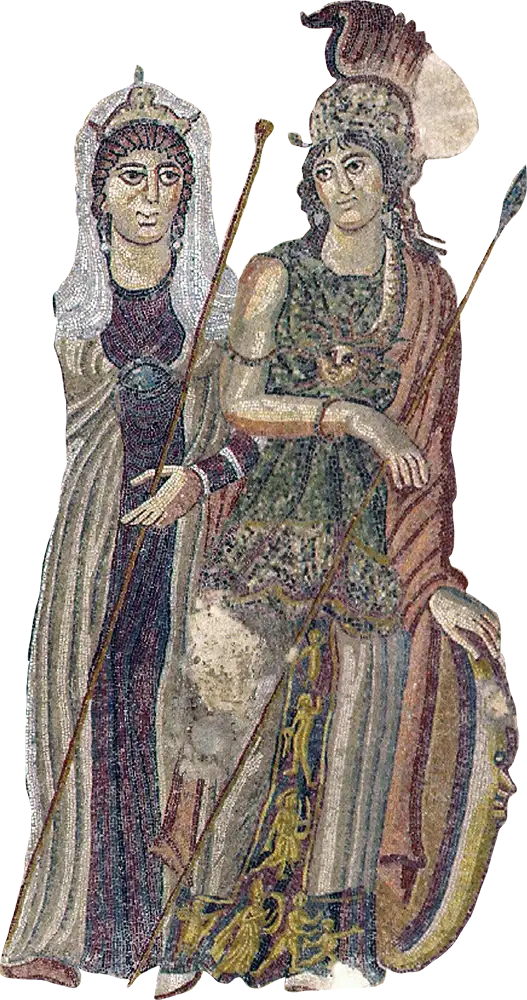
A new phase began in 2008 with the aim of carrying out a comprehensive study of the archaeological site, without forgetting the mosaic. In fact, it was in that year that the triclinium triabsidium with a surface area of 290.64 m2 where the famous mosaic was located.
In 2012 the villa Noheda was declared an Asset of Cultural Interest (BIC). Since then, different archaeological campaigns have been carried out, which have allowed the exhumation of 5% of the total surface of the site, with a good number of discoveries that show the relevance of this enclave in the international panorama.
Research has uncovered the existence of a rural complex dating back to the High Empire, although it is the only one of its kind in the villa Late Roman settlement of the 4th century, the most notorious evidence of which remains have been preserved. After this peak period, the settlement was reoccupied on a residual basis until well into the following century.
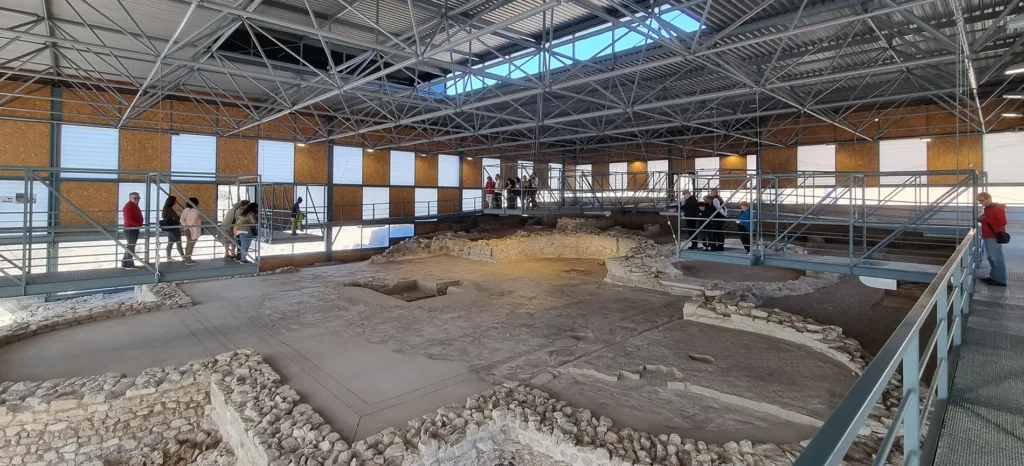
With regard to the revaluation and museography of the site, it should be noted that the complexity of conserving a mosaic of such magnitude has required the intervention of teams specialised in preventive conservation and museum restoration. Structural solutions such as protective roofs, passive climate control systems and environmental control protocols have been used to guarantee the preservation of the site without compromising the public's view of it, and guaranteeing universal accessibility.
The musealisation of the site has followed contemporary criteria of integration between the archaeological discourse and the visitor experience. Elevated walkways, interpretative panels and augmented reality resources allow for an immersive tour of the original space, without interfering with the conservation of the heritage elements. The revaluation of the villa of Noheda has been carried out thanks to the collaboration between local, provincial, regional and state administrations, as well as with the support of universities and research centres. This cooperation model has allowed not only the enhancement of the site, but also its inclusion in international research networks, promoting the exchange of knowledge and citizen participation. The villa Romana de Noheda represents, in short, an outstanding example of how rigorous archaeological research, combined with sustainable conservation and dissemination strategies, can transform a find into a living cultural asset, capable of generating knowledge, identity and territorial development.
Take the N-320 road towards Guadalajara as far as Noheda, 2 km after passing through the village of Noheda.
info@villanoheda.org
Tel: 610 57 94 51
Design and implementation: Tragsa Group. Contents: Miguel Ángel Valero Tévar, scientific director of the archaeological site of the Roman villa of Noheda with the collaboration of the Tragsa Group.
All content and images on this website are protected by copyright. Use without consent is prohibited.
© 2025 - Roman Villa of Noheda